

What MOQ Strikes the Right Balance Between Sock Factories and Brands?
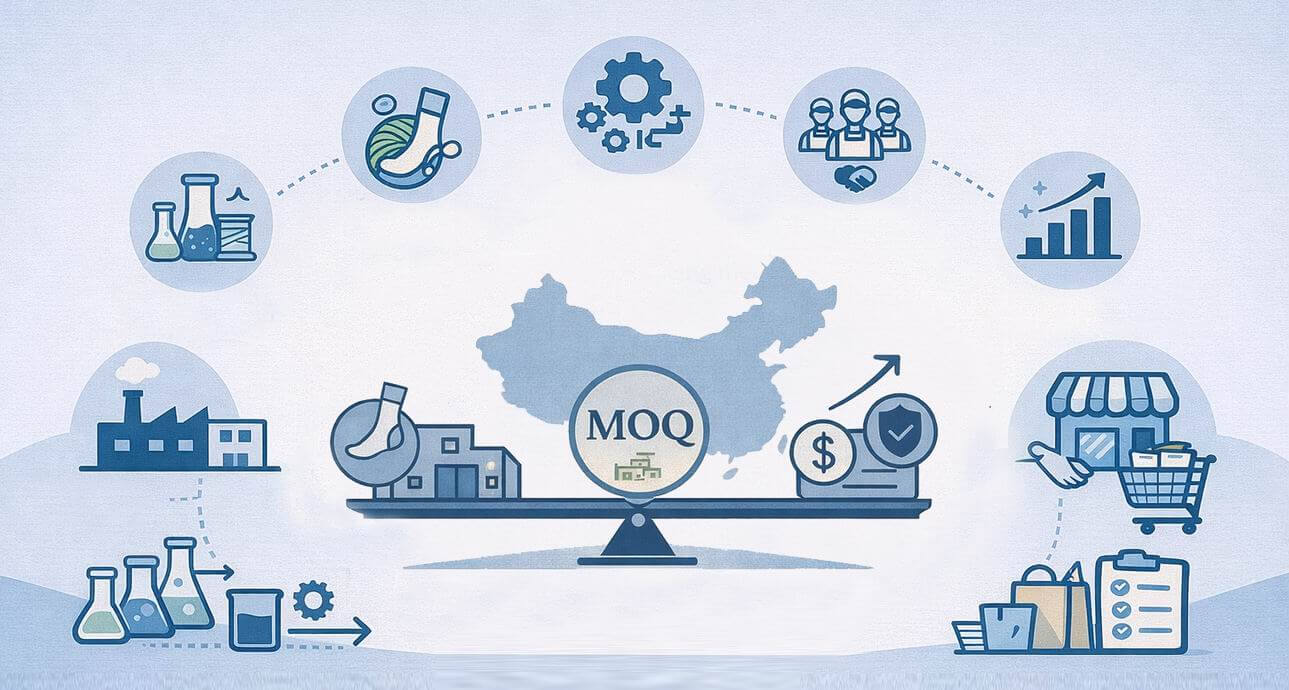
In the sock manufacturing industry, the Minimum Order Quantity (MOQ) is not just a number—it reflects the balance between supply chain capability, cost structure, and product positioning built up over years of industry practice.
For brands, understanding the logic behind MOQ helps you make smarter and more efficient decisions when customising socks.
1. The Core Factors That Influence MOQ
— Yarn MOQ Requirements
Yarn type is the single most influential factor in MOQ. Different dyeing methods determine production flexibility and order thresholds.
- Dyed Yarn (spinning first, dyeing later): The yarn is produced first and dyed afterwards. Its advantages include Flexible production batches, Easier colour adjustment, MOQ mainly depends on dyeing vat capacity. This method suits basic and multi-colour styles where individual colour orders don’t need to be large.
- Yarn-Dyed (dyeing raw material before spinning): The fibres are dyed before spinning. It usually involves Larger batch sizes, Often used in functional or jacquard socks, Higher inventory and production risk. As a result, yarn-dyed products generally require significantly higher MOQs.
— Cost and Production Efficiency
MOQ is ultimately about finding a workable balance between cost, efficiency and quality.
- Some costs exist regardless of order size: Dyeing and colour matching, Changing yarn and cleaning, Machine setup, Production scheduling and switching.
- When orders are too fragmented: Production flow becomes unstable, Unit cost rises, Error and waste rates increase, Rework risk goes up.
For factories, MOQ helps control these hidden costs. For brands, MOQ ensures stable quality and reliable lead times.
— Management Capability
Sock manufacturing depends heavily on skilled labour and organised production. Too many small orders may cause: Inconsistent workmanship, Frequent production switching, Higher management cost.
Other factors like needle count, size breakdowns or packaging may also affect complexity—but usually only to a smaller degree.
2. Common MOQ Ranges in the Industry
There is no strict industry standard, but long-term market practice has formed general ranges:
— Small to Medium Factories
- Dyed Regular yarn: around 300 pairs per style
- Dyed Functional or premium yarn: around 600 pairs per style
- Yarn-dyed: Usually around 1,000 pairs per style
— Why Large Factories Have Higher MOQs
- They operate with larger-scale processes
- Staff are specialized in mass production
- Efficient capacity planning is a priority
Small and medium factories tend to be more flexible, while larger factories suit brands with steady, high-volume orders.
3. Suggestions for Global Brands
If your product direction and sales goals are not clear yet, it’s difficult to judge whether an MOQ is reasonable.
Choosing a suitable MOQ is more important than simply choosing the lowest one.
— Choose the right factory type
- For new brands or trial runs, a smaller specialised factory is more suitable.
- For scaling up, medium or large factories offer better stability and capacity.
— Choose common and cost-efficient yarn systems
Especially for new collections:
- For dyed yarn: choose proven blended systems
- For yarn-dyed: choose standard colours or stock yarns to reduce MOQ pressure
Good factories don’t just quote prices—great ones offer yarn solutions and technical advice that reduce long-term risks and cost.
Conclusion
MOQ is shaped by a combination of material requirements, production cost, efficiency and quality stability. For global brands, the goal is to find the balance that fits your product positioning, reduces risk, and supports long-term cooperation.
Contact Us
Don’t miss out on the opportunity to partner with a trusted bamboo socks manufacturer from China. Let us help you create products that resonate with your customers and elevate your brand.