

Sock Production Lead Time Explained: 10 Delay Reasons and How Buyers Can Avoid Them
Although socks may appear simple in design, the journey from initial concept approval to final shipment involves multiple production stages, including pattern programming, yarn and accessory preparation, sample development, knitting, toe linking, boarding, inspection, pairing and packing.
Any delay or poor coordination at one stage can affect the final delivery schedule.
For orders using standard yarns, regular packaging and approved samples, bulk production usually takes around 30–45 days. When calculated from the initial design development and sampling stage, the overall production timeline is generally around 45–75 days.
For orders involving custom-dyed yarns, complex jacquard designs, special performance requirements, third-party testing or peak-season production schedules, the timeline may extend to 60–90 days or even longer.
The actual lead time depends on the product construction, order quantity, material availability, factory production schedule and inspection requirements.
From a sock manufacturer’s perspective, the following are the 10 most common reasons for production delays and the practical steps overseas buyers can take to avoid them.
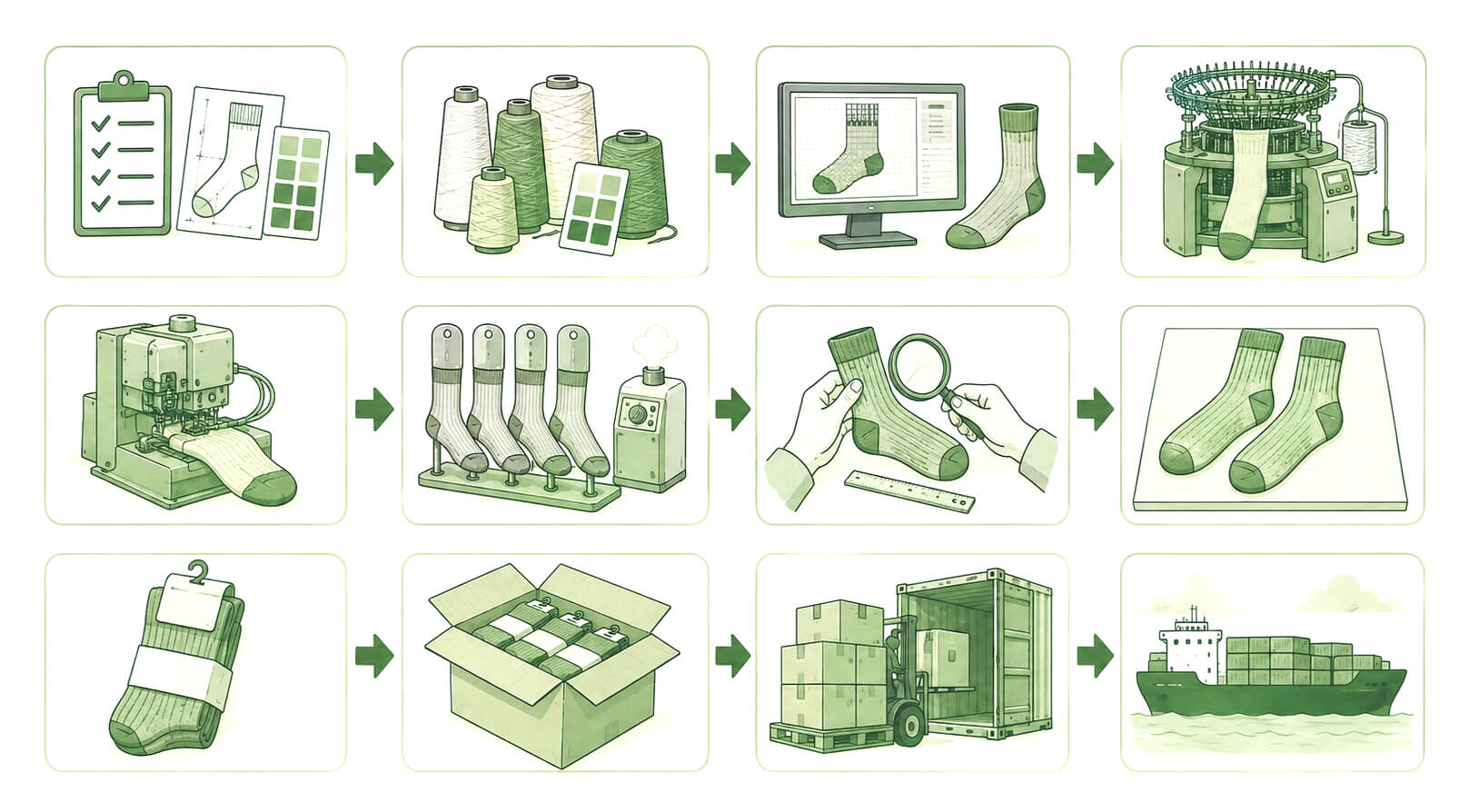
1. Product Development and Approval Stage
1.1 Incomplete Product Information or Unclear Requirements
One of the most common causes of delays happens before production even begins.
Some buyers provide only low-resolution images, simple sketches or verbal descriptions, without confirming important details such as sock style, sizing, yarn composition, colours, pattern placement, needle count, cushioning areas or packaging requirements.
Without complete product information, the factory cannot accurately prepare knitting programmes, calculate costs or confirm production requirements. This often leads to multiple rounds of communication and extends the development timeline.
To avoid this, buyers should provide clear design files such as AI or PDF formats wherever possible, along with high-resolution images or physical reference samples. Important details, including Pantone colours, size range, sock height, pattern position, cushioning and rib requirements, yarn composition and packaging method, should also be confirmed at the beginning.
The more complete the product specifications are, the easier it is for the factory to assess the correct production process, pricing and delivery schedule.
1.2 Sample Changes and Delayed Approval
Sock sampling involves several technical steps, including pattern preparation, programming, yarn colour matching, machine adjustment and size correction.
A standard first sample usually requires around 7–14 days, while more complicated designs or custom yarn requirements may take longer. If samples need to be sent internationally, or if several departments are involved in the buyer’s approval process, each round of changes can add another one to three weeks.
To minimise delays, factories can provide pattern visuals, sock artwork layouts or trial knitting images to confirm colours, designs and placement before physical samples are completed.
However, final confirmation should always be based on physical samples, as factors such as sizing, elasticity, thickness, hand feel and wearing comfort cannot be fully judged from images alone.
Once samples are received, buyers should aim to provide clear and consolidated feedback within 24–48 hours. Combining comments from different departments into one response helps avoid repeated changes and conflicting instructions.
1.3 Custom Yarn and Special Material Preparation
Standard yarns such as cotton, polyester and nylon are generally easier to source. However, customised colours, merino wool, recycled yarns, certified materials and performance yarns may require additional purchasing or dyeing processes.
Minimum order quantities, supplier production schedules and colour approval requirements can all affect delivery times. These materials often add an additional two to four weeks to the production timeline, while some specialised materials may require even longer.
For regular orders, buyers should consider selecting colours from the factory’s existing yarn range or established supply system where possible.
For orders requiring custom dyeing, special fibre compositions or certification standards, material specifications, testing requirements and target market requirements should be confirmed at the development stage. Sufficient time should be allowed for yarn sourcing, dyeing and testing before production begins.
2. Production Scheduling and Material Preparation Stage
2.1 Production Planning Not Matched with Factory Capacity
Production lead time does not simply depend on the number of knitting machines available.
It is also affected by factors such as suitable machine types, needle count, pattern complexity, production efficiency, toe linking capacity, boarding capacity and packing resources.
A factory may have strong overall production capability, but specific machines or processes required for a particular sock style may already be fully scheduled.
Before placing a confirmed order, buyers should ask the factory to review actual production capacity based on the approved design, order quantity and required delivery date.
Key production milestones, including sample approval, material readiness, production start, packing completion and estimated shipment date, should be confirmed clearly.
For peak-season orders, communication should begin two to three months in advance. Buyers should not rely only on a factory’s advertised monthly production capacity when evaluating delivery capability.
2.2 Packaging Materials Not Prepared Alongside Bulk Production
A common delay occurs when the socks have already been produced, but the required packaging materials are not ready.
Items such as hangtags, belly bands, hooks, paper cards, barcode labels, size stickers and carton markings must all be available before finished products can be packed and shipped.
This situation is often caused by late artwork approval, incorrect barcode information, packaging supplier delays or late delivery of buyer-appointed packaging materials.
Once the bulk order is confirmed, packaging specifications, printing files, barcode details, packing ratios and carton marking requirements should be finalised as early as possible.
Whether packaging is arranged by the sock factory or supplied by the buyer’s nominated supplier, both sides should clearly confirm responsibility, delivery timing and inspection standards. Packaging materials should ideally be checked before the production reaches the final packing stage.
2.3 Production Progress Tracking and Communication Gaps
A lack of regular production tracking can also create unexpected delays.
If purchasing, production, quality control and sales teams are working with different versions of order information, or if progress is only checked shortly before the shipment deadline, problems such as material shortages, insufficient production output or quality issues may not be identified early enough.
To avoid this situation, buyers should agree with the supplier on a regular progress update schedule and monitor key production stages, including material preparation, production start, knitting completion, toe linking, boarding, inspection, packing and shipment.
For important orders, both parties should assign clear points of contact and use consistent versions of specification sheets, packaging information and change records.
A supplier’s ability to identify and report potential risks early is often a more reliable indicator of delivery management capability than factory size alone.
3. Mass Production and Quality Control Stage
3.1 Machine Adjustment and Unstable Pattern Results
Complex designs can create challenges when moving from sample production into bulk manufacturing.
Jacquard patterns, small text designs, multi-colour graphics and high needle-count socks may experience issues such as stretched patterns, incorrect placement, loose floating yarns, size variations or differences between machines.
When these problems occur, the factory may need to stop production and adjust knitting programmes, yarn tension or machine settings, which can affect the production schedule.
Before bulk production begins, buyers should approve a pre-production sample or sealed reference sample and confirm acceptable production tolerances.
After the first production pieces come off the machines, the factory should carry out a first-piece inspection to confirm that the production result matches the approved sample.
During the knitting process, regular quality checks should also be carried out to monitor dimensions, pattern accuracy, broken yarns, missing stitches and fabric structure. Identifying issues early helps prevent larger problems across the entire production batch.
3.2 Toe Linking Process Not Matching Product Requirements
After socks are knitted, the toe area usually requires linking before the finishing process.
Standard toe linking machines provide good production efficiency and are suitable for most regular sock orders. However, special toe finishing methods, such as smoother seam construction, can provide better comfort but require more specialised equipment, skilled operators and additional production time.
If the toe linking method is changed after bulk production has already started, or if the required production capacity has not been properly assessed, delays can occur.
The toe linking method and seam requirements should therefore be confirmed during the quotation and sampling stage.
For premium socks, sports socks or products where toe comfort is a key selling point, the required production time should be considered from the beginning. Manufacturing processes should not be upgraded or changed during the final stage of bulk production.
3.3 Failed Inspection Causing Rework or Additional Production
Quality issues discovered during or after production can significantly affect delivery schedules.
Problems such as incorrect sizing, inconsistent pairing, pattern misalignment, holes, missing stitches, colour differences, stains, insufficient elasticity, shrinkage issues or poor colour fastness may require rework, additional finishing or even full reproduction.
The impact becomes much greater when systematic problems are only identified during final inspection.
To minimise this risk, buyers should confirm quality standards before production begins, including measurement tolerances, appearance requirements, testing requirements, inspection methods and inspection timing.
Quality control should not rely only on final inspection. A reliable factory should carry out checks throughout the production process, including yarn inspection, knitting checks, toe linking checks, boarding checks and packing inspection.
For products involving colour fastness, fibre composition, antibacterial claims or other functional features, testing methods, acceptance standards and approved testing organisations should also be confirmed in advance.
4. Change Management and External Factors
4.1 Last-Minute Changes, Communication Issues and Holiday Impact
Changes made after sample approval are one of the common reasons for production delays.
Adjustments to colours, size ratios, quantities, packaging or labels may require new material preparation, programme changes, rework or production rescheduling.
In addition, external factors such as Chinese New Year, National Day holidays and international logistics fluctuations can affect raw material supply, factory staffing, inspection schedules and shipping arrangements.
To avoid delays, all changes should be confirmed in writing, and the factory should reassess both the cost impact and revised delivery schedule before proceeding.
The impact of Chinese New Year is usually much greater than the holiday period itself. Production planning before the holiday, supplier shutdowns, workers returning home and the time required for factories to return to normal capacity after the holiday can affect manufacturing and logistics for four to six weeks or even longer.
For orders scheduled around Chinese New Year, buyers should confirm samples and materials as early as possible and allow additional buffer time.
Conclusion
Managing sock production lead time is not simply about asking the factory to “produce faster”. The key is ensuring that product specifications, sample approval, material preparation, actual production capacity, quality standards and shipment arrangements all move according to the same schedule.
For overseas buyers, following the “three early principles” can significantly reduce avoidable delays.
Plan early by working backwards from the target launch date or warehouse arrival date and arranging production and shipping schedules in advance.
Approve early by providing clear and consolidated feedback on samples, colours and packaging details within 24–48 hours wherever possible.
Communicate early by informing the factory immediately about any changes to product design, sales plans or inspection requirements, allowing production arrangements to be reviewed in time.
A reliable delivery schedule is not achieved simply through faster production. It comes from clear specifications, timely decisions, realistic planning and close cooperation between buyers and manufacturers.
Contact Us
Don’t miss out on the opportunity to partner with a trusted bamboo socks manufacturer from China. Let us help you create products that resonate with your customers and elevate your brand.