

How Sock Pricing Is Calculated Full Cost Breakdown for Private Label & OEM Buyers?
rom a manufacturing perspective, the cost of a pair of socks is never driven by just one factor. It’s a combination of materials, construction, labour, machinery, wastage, packaging, overheads, and order volume—all working together.
For overseas buyers, understanding how these costs are built up does more than explain a price. It helps create alignment. It makes product development smoother, pricing discussions more transparent, and long-term partnerships easier to manage.
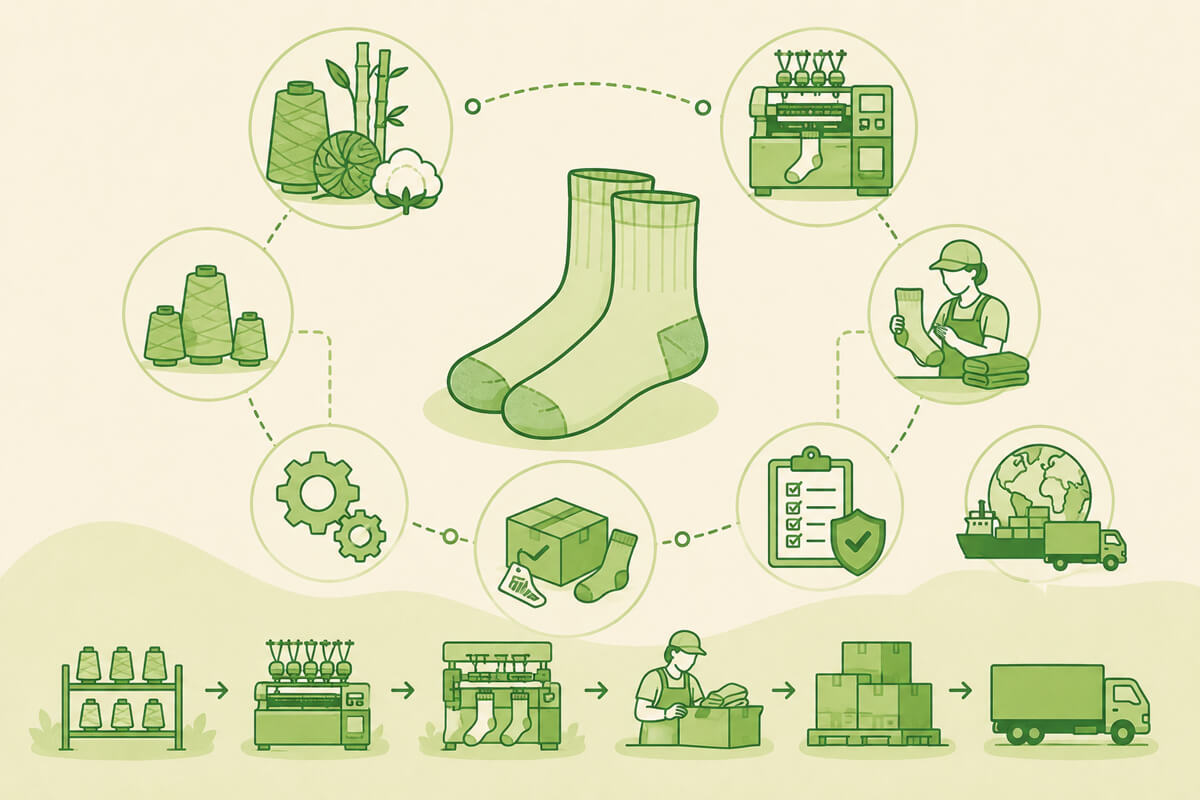
1.Materials: Where Most of the Cost Starts
In most cases, materials make up the largest portion of the cost—and the biggest source of price variation.
Not all yarns are created equal. Standard cotton, combed cotton, polyester, nylon, acrylic, bamboo, TENCEL™, and merino wool all sit at very different price points. A basic cotton sock is relatively cost-effective. But once you move into higher-end materials—like merino blends, Coolmax, antibacterial yarns, or recycled fibres—the cost per pair rises quickly.
And it’s never just about the “main yarn”.
A single pair of socks also includes elastane, rubber threads, stitching yarn, reinforcement yarns, and dyeing costs. On top of that, sock length matters. No-show socks, ankle socks, crew socks, and knee-high styles all use different amounts of material, which directly affects the final price.
When a factory quotes a price, one of the first things they look at is the weight per pair, the yarn cost, and the expected material wastage.
2.Construction: Why Similar Socks Can Cost Very Different Prices
At first glance, two pairs of socks might look similar. In production, they can be completely different.
Modern sock manufacturing is highly automated, but not all designs run at the same efficiency. A plain sock is straightforward. A multi-colour jacquard, a sports sock with cushioning, or a compression sock is not.
The more complex the design, the more it slows things down.
Patterns need to be programmed into machine-readable formats. Multi-colour designs require more yarn changes and machine adjustments. Features like embroidered logos, targeted cushioning, seamless toes, or special finishing processes all add extra steps.
What this means in practical terms is simple. You’re not just paying for a pair of socks—you’re paying for the complexity behind how they’re made.
3.Labour: Still a Key Part of the Process
Even with automation, labour still plays an important role.
Machines handle the knitting, but many steps still rely on people—linking, turning, shaping, inspection, pairing, and packing.
For higher-quality products, expectations are tighter. Consistent sizing, clean stitching, proper elasticity, accurate pairing, and overall presentation all require more skilled workers and stricter quality control.
If the design is more complex or involves semi-manual steps, labour input increases further.
From a buyer’s perspective, this part of the cost is directly tied to production stability and quality consistency.
4.Manufacturing Overheads: The Hidden Backbone
Behind every stable factory is a significant investment in equipment and operations.
Computerised knitting machines, linking machines, boarding equipment, needle detectors, and packaging lines all require ongoing investment, maintenance, and energy to run. Add factory rent, management staff, repairs, consumables, and daily operations, and the picture becomes clearer.
These costs don’t always get noticed, but they’re always there.
They’re typically built into the unit price as part of overall manufacturing overhead. And this is where order size starts to matter. Larger orders spread these costs more efficiently, while smaller runs carry a higher share per unit.
5.Wastage and Defect Rates: The Cost You Don’t See
This is one of the most overlooked parts of pricing—but one of the most important from a manufacturing standpoint.
From sampling through to bulk production, some level of wastage is unavoidable. Machine setup losses, colour variations, knitting defects, linking issues, shaping inconsistencies, or packing errors can all occur.
For new designs, complex structures, or strict specifications, early-stage losses are often higher.
Experienced factories don’t ignore this—they plan for it.
Because without factoring in realistic wastage, it becomes very difficult to maintain stable quality across bulk orders. In many cases, pricing that seems unusually low is simply not accounting for this properly.
And that usually shows up later in quality issues.
6.Packaging and Additional Requirements
For OEM and brand buyers, socks rarely ship as a bare product.
They often require full retail-ready packaging—belly bands, hang tags, J-hooks, stickers, barcodes, individual polybags, gift boxes, or multi-pack sets. In some cases, products also need to be pre-packed according to retail display requirements.
If sustainability is part of the brief, options like FSC-certified paper or biodegradable packaging can add further cost.
On top of that, some buyers require third-party testing, fibre composition reports, colour fastness testing, needle detection reports, or social compliance audits. These are all part of the broader cost structure of an order.
7.Order Volume: One of the Biggest Pricing Factors
In the sock industry, scale makes a real difference.
Larger orders allow factories to secure better raw material pricing, reduce machine downtime from frequent style changes, and spread fixed costs—like sampling, setup, and management—across more units.
That’s why pricing for 2,000 pairs and 10,000 pairs can look quite different.
For buyers, this usually means that consolidating quantities—fewer colours, fewer fragmented SKUs, and more standardised materials or packaging—can lead to more competitive pricing overall.
# Conclusion
The cost of a pair of socks is never just “material plus labour”.
It’s shaped by materials, construction complexity, labour input, equipment investment, wastage control, packaging requirements, and order scale—all working together.
A truly competitive price isn’t simply the lowest one on paper.
It’s the one that balances quality, consistency, delivery reliability, and long-term sustainability.
Because in the end, that’s what actually supports your business—not just the unit price.
Contact Us
Don’t miss out on the opportunity to partner with a trusted bamboo socks manufacturer from China. Let us help you create products that resonate with your customers and elevate your brand.