

DDP vs FOB for Sock Imports Cost, Risk & Responsibility Comparison for Global Retailers
DDP and FOB are two of the most commonly compared trade terms in sock imports. There is no absolute right or wrong choice. The key depends on the buyer’s import experience, order volume, logistics capability and risk tolerance.
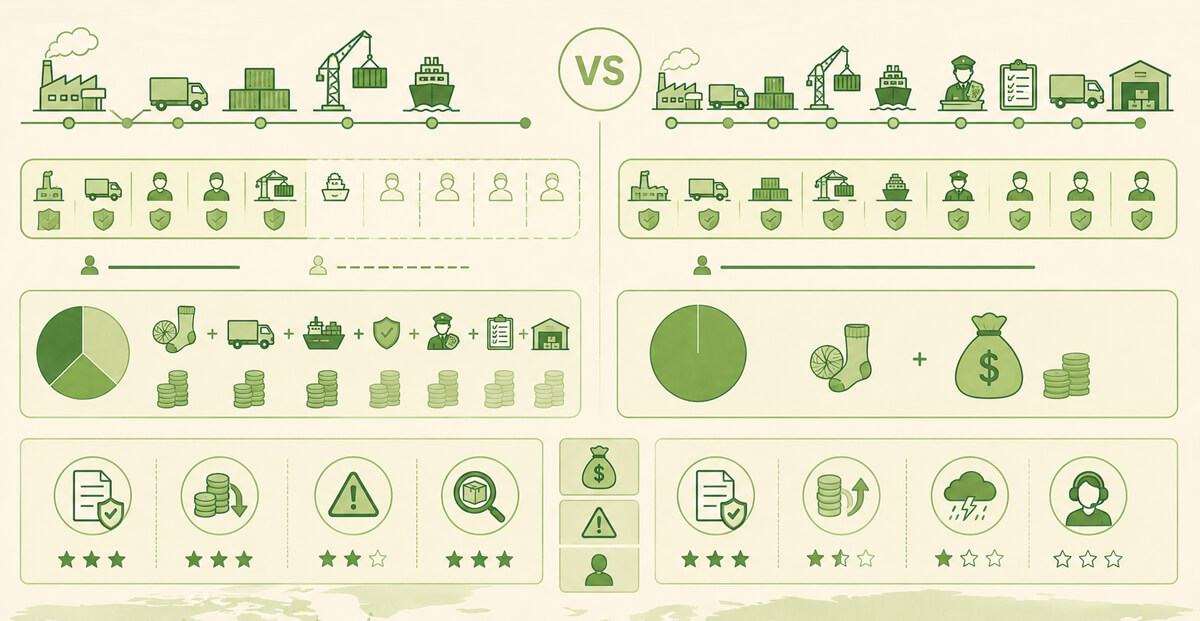
1.What Exactly Are DDP and FOB?
Put simply, FOB, or Free On Board, means the seller’s responsibility ends once the goods have been loaded onto the vessel at the export port. After that, sea freight, insurance, destination customs clearance, import duties, GST or VAT, and delivery to the buyer’s warehouse are all handled by the buyer or the buyer’s freight forwarder.
DDP, or Delivered Duty Paid, means the seller takes on all costs and risks from the factory to the buyer’s nominated address. This includes international transport, import and export customs clearance, destination country duties and taxes, and delivery to the buyer. The buyer only needs to unload the goods.
On the surface, DDP may seem more convenient: one price, one contact, and no need to worry about logistics details. However, as a manufacturer, we need to be upfront: for regular consumer goods such as socks, DDP carries significant hidden risks, while FOB is the more transparent, controllable and safer option.
2.Cost Comparison: Transparent vs Bundled
Under FOB, the buyer can see a clear breakdown of costs: the ex-factory price of the socks, trucking from the factory to the port, export customs declaration fees, sea freight or air freight, insurance, destination port charges, import duties and GST or VAT, and final-mile delivery.
Each item can be quoted, compared and negotiated separately. Once buyers understand the market, they can reduce long-term purchasing costs by choosing their own freight forwarder and customs broker.
Under DDP, all costs are bundled into one total price. The buyer cannot know how much the sea freight is, what customs value the duties are based on, or how much margin the seller has added. More importantly, when a buyer sources different products from multiple Chinese suppliers, bundled DDP pricing makes it difficult to compare whether the logistics cost is reasonable.
Transparent costs bring real control. Bundled pricing often means a premium.
3.Risk Allocation: The Biggest Trap in DDP
Many buyers choose DDP because they believe “the seller takes care of everything, so the buyer has zero risk”. This is one of the most dangerous misunderstandings in international trade.
One rule must be kept in mind: in mature markets such as Europe, the United States, Canada and Australia, the importer, as the final consignee of the goods, is always the party ultimately responsible for customs compliance. No matter how the contract is written, customs authorities recognise the Importer of Record, or IOR.
Why is this especially important for sock imports? Socks have clear tariff classifications, and fibre composition declarations are sensitive. Cotton socks, synthetic socks and wool socks can have very different duty rates. Country of origin labels and fibre content must be declared accurately.
Some non-compliant suppliers may try to reduce costs in their DDP quote by using improper practices, such as under-declaring the customs value, for example declaring USD 2.00 per pair as USD 0.50 per pair; misdeclaring the product name, such as declaring cotton socks as synthetic socks to access a lower duty rate; or misrepresenting the fibre composition, such as declaring 80% cotton as 50% cotton.
If customs selects the shipment for inspection, the consequences will fall on the importer.
Under FOB, import customs clearance is handled by the customs broker appointed by the importer. The importer has full control over the truthfulness and compliance of the declaration data. No third party has the opportunity to make an illegal declaration on the importer’s behalf, and the importer will not be exposed to joint responsibility for the seller’s illegal conduct.
Customs compliance must remain in the importer’s own hands.
4.Responsibility: Let Each Party Do What They Do Best
As a manufacturer, our strengths are product development, quality control, on-time production, export trucking and export customs declaration. These are the areas where we have an advantage within China.
International transport, destination customs clearance, duty payment and local delivery are matters in the buyer’s market. Buyers understand their local freight forwarders, customs brokers and logistics companies better than any Chinese supplier, and are better placed to control the cost and service quality of those steps.
When the buyer chooses FOB, both parties have a clear division of responsibility. The seller loads the socks onto the vessel in good condition and provides the full set of export documents, such as the commercial invoice, packing list, bill of lading and certificate of origin.
Everything after that is handled smoothly by the buyer and their local team or freight forwarder. If there is a vessel delay, port congestion or customs inspection, the buyer can communicate directly with the freight forwarder instead of going through the seller. The response is faster and the information is more accurate.
If DDP is chosen, every issue needs to be passed through the seller, and the buyer loses the ability to directly coordinate and solve problems. In addition, as a factory, the seller’s understanding of the buyer’s local import regulations and customs policies is far below that of the buyer’s local customs broker.
Asking a factory to take on destination-country compliance responsibilities that it is not specialised in is, in itself, a mismatch of risk.
5.Practical Advice for Sock Buyers
Based on ten years of experience serving overseas clients, our recommendation is clear.
For the vast majority of regular sock purchases, whether for wholesalers placing stable quarterly replenishment orders or buyers developing their own private label brands, FOB terms are recommended.
The buyer only needs to nominate a reliable freight forwarder at the Chinese port, or use an existing freight partner, and the seller will cooperate with shipment arrangements. The buyer will achieve the best outcome in terms of cost transparency, compliance control and long-term optimisation.
If the buyer does not yet have a freight forwarder, the seller can recommend several established freight forwarders with long-term cooperation experience for comparison. However, the final choice and signing authority should remain with the buyer.
For customers sourcing from China for the first time, FOB may sound like it involves more steps than DDP. In practice, once a reliable freight forwarder is in place, the FOB process is very mature and straightforward.
Many customers find after their first FOB shipment that controlling their own logistics is much more secure and cost-effective than relying on a bundled quote from someone else.
# Conclusion
Overall, DDP and FOB are not simply a difference in price. They are a difference in purchasing model and responsibility structure.
DDP suits global retailers who prioritise convenience, lower perceived risk and a fixed budget. FOB suits global retailers who value transparency, control and long-term cost optimisation.
For sock imports, choosing the right trade terms can help global retailers reduce misunderstandings, control risk, and build a more stable and efficient long-term relationship with the manufacturer.
Contact Us
Don’t miss out on the opportunity to partner with a trusted bamboo socks manufacturer from China. Let us help you create products that resonate with your customers and elevate your brand.