

Socks AQL Inspection Guide: Aligning Sampling Plans, Key Defects and Acceptance Standards
Pre-shipment inspection is an important part of controlling purchasing risk. However, whether it actually works depends on whether both parties have clearly agreed on the sampling method, defect classification and acceptance criteria before the order is placed. Simply writing “AQL 2.5” on an order is not enough to form a complete quality agreement.
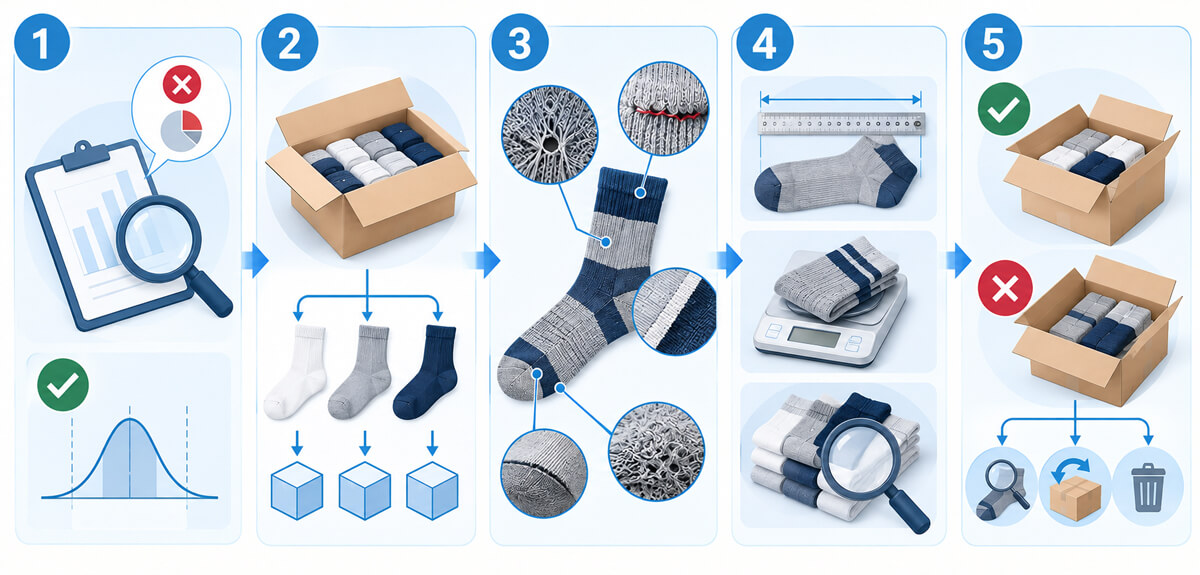
1. First, Correct a Common Misunderstanding
AQL stands for Acceptance Quality Limit. It is a parameter used to select a sampling inspection plan. It should not be understood simply as allowing 2.5% defective goods in the whole batch, nor does it mean that every pair of socks is problem-free once the inspection is passed.
The buyer and seller should agree on the standard and version to be used, such as ISO 2859-1, and clearly define the inspection level, sampling plan, inspection lot and inspection unit. Sampling inspection is used to decide whether a batch can be accepted. It cannot replace quality control during the production process.
2. Sampling Plan: Inspection Lot, Inspection Level and Random Selection
When setting up the inspection plan, the first step is to define the inspection lot and inspection unit. Socks can be inspected by pair. For multi-pair packs, the full pack combination also needs to be checked. Whether different styles, materials or production batches can be combined should be agreed in advance.
Taking 5,000 pairs of socks as one inspection lot and counting by pair as an example, if General Inspection Level II and normal single sampling are used, the sample size is 200 pairs. When major defects are set at AQL 2.5, the acceptance number is 10 and the rejection number is 11. This means that if 11 pairs with this type of defect are found, the inspection item fails. It is not calculated by simply multiplying 200 by 2.5%.
Samples should be randomly selected by the inspector from different carton positions, and should cover colours and sizes as agreed. They should not be pre-selected by the factory. For orders with many styles and small quantities, it is also important to avoid situations where some styles are not sampled at all. Before inspection, the production completion rate, packing status and available quantity for sampling should be confirmed, so that partially completed goods are not used to represent an unfinished order.
3. Key Defects: Classifying Issues by Safety, Function and Sales Impact
Defect classification should be based on safety, wearing function and sales impact. Safety risks such as broken needles or sharp metal contamination should be treated as critical defects, with the batch rejected if one case is found.
Issues such as holes, missed stitches, open toes, obvious size deviations, failed elasticity or incorrect pairing are usually treated as major defects. Minor appearance issues that do not affect use or saleability may be classified as minor defects. The exact boundary should be confirmed through photos or physical examples, rather than judging the defect level only by general terms such as “loose threads” or “colour difference”.
4. Acceptance Standards: Measurable, Comparable and Practical
Acceptance standards must be translated into measurable requirements. For sizing, the measuring position, whether the sock is measured flat or stretched, and the allowed tolerance should be clearly defined. It is not suitable to apply the same tolerance to all sock types.
Colour, pattern, hand feel and toe finishing should be checked against the approved sample and written specifications. Packaging should be checked against size, barcode, labelling, packing ratio and carton marks. If one pair of socks has multiple issues, the counting rule for defective pieces should also be agreed to avoid disputes caused by duplicate counting.
Visual inspection cannot replace performance testing. Fibre composition, dimensional change after washing, colour fastness and the pressure performance of compression socks should be covered by separately agreed testing methods and acceptance requirements. Even if the visual inspection is passed, a failure in key testing items should not automatically be released.
5.What Happens If the Inspection Fails?
If the inspection fails, the manufacturer should identify the cause, sort or rework the affected batch, and then arrange a re-inspection. It should not simply replace the defective pieces found in the sampled goods.
For buyers, reliable AQL inspection starts with aligning standards before the order is placed. For manufacturers, stable delivery depends on process control from yarn, knitting and boarding through to pairing and packing.
Conclusion
AQL 2.5 is an important baseline for supplying socks to the retail market. Only when the standard version, sampling plan, defect definitions, measuring methods and handling process for non-conforming goods are written into the quality agreement can inspection genuinely protect both the buyer and the seller.
Contact Us
Don’t miss out on the opportunity to partner with a trusted bamboo socks manufacturer from China. Let us help you create products that resonate with your customers and elevate your brand.