

Shipping Socks from China: Sea Freight vs. Air Freight vs. Courier – Which is Best?
Choosing the right shipping method for socks sourced from China involves more than comparing freight rates. Your decision affects stock availability, launch dates, cash flow and profit margins.
Sea freight is usually the most economical option for bulk orders, but it has the longest lead time. Air freight is much faster, although the cost is significantly higher. International couriers such as DHL, FedEx and UPS offer a straightforward door-to-door service, making them suitable for samples, small orders and urgent top-ups.
The key figure is not the headline rate per kilogram or cubic metre. What matters is the total landed cost, including freight, surcharges, customs clearance, import taxes, local delivery and the potential cost of delays.
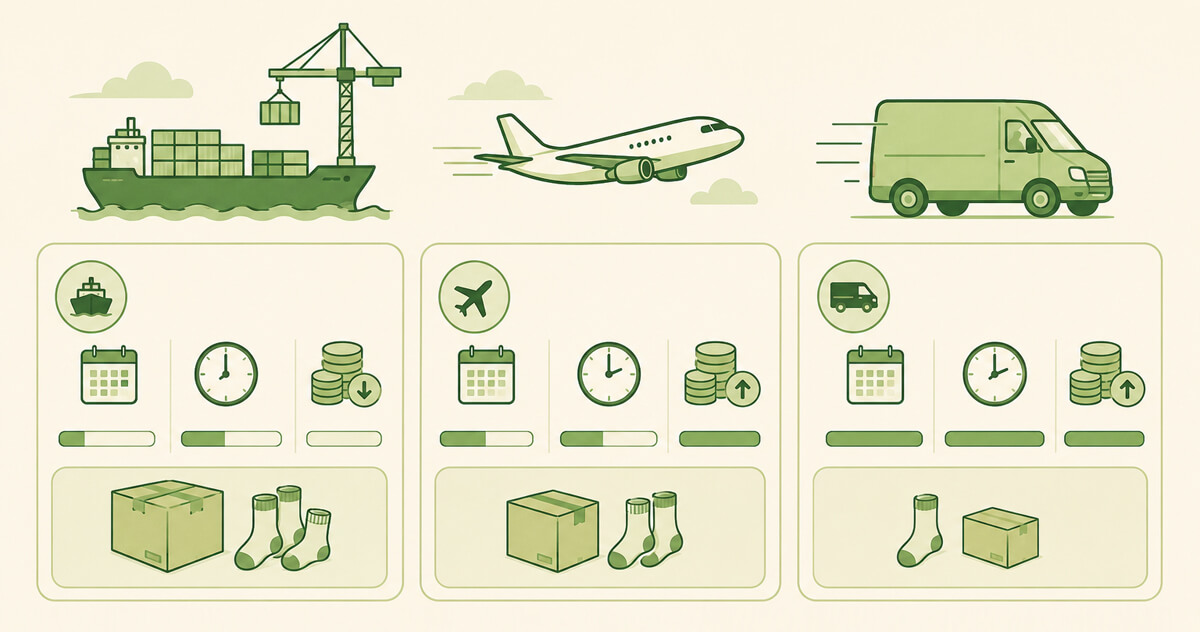
1.Comparing the Three Shipping Options
1.1. Sea Freight: Best for Planned Bulk Orders
Sea freight remains the most common option for larger sock orders.
Less-than-container-load shipments, or LCL, are generally charged by volume or revenue ton. Full-container-load shipments, or FCL, are quoted by container size, such as a 20-foot, 40-foot or 40-foot high-cube container.
As at mid-2026, indicative LCL rates from China to Australia’s east coast ports, including Sydney, Melbourne and Brisbane, are around USD 45 to 90 per cubic metre. A 20-foot container may cost approximately USD 1,800 to 3,200, while a 40-foot high-cube container may range from USD 2,800 to 4,500.
For Northern European ports such as Rotterdam, Hamburg and Antwerp, indicative 20-foot container rates are around USD 1,500 to 3,000. Rates to Western European ports such as Felixstowe and Le Havre are broadly similar, depending on the carrier, routing and destination port.
These figures cover basic ocean freight only. Origin charges, destination charges, fuel surcharges, customs clearance and inland delivery may be charged separately. Freight rates can change quickly, so always obtain an up-to-date written quote before booking.
Typical port-to-port transit times are:
— China to Sydney, Melbourne or Brisbane: approximately 15 to 25 days
— China to Fremantle: approximately 12 to 18 days
— China to Northern Europe: approximately 28 to 45 days
— China to Western Europe: approximately 30 to 42 days
Door-to-door delivery normally takes longer. Allow additional time for cargo consolidation, export procedures, customs clearance and local transport. In many cases, these stages add another 5 to 12 days.
Sea freight is generally suitable when:
* the shipment is larger than two or three cubic metres;
* the order is planned well in advance;
* the goods are for routine stock replenishment; and
* keeping the freight cost per unit low is the main priority.
For larger, non-urgent orders, sea freight will usually provide the lowest overall logistics cost.
1.2. Air Freight: Faster but More Expensive
Air freight is charged according to chargeable weight. This is the higher of the actual gross weight and the volumetric weight.
A common volumetric formula for standard air cargo is:
— Length × width × height in centimetres ÷ 6000**
However, the divisor can vary, so confirm the calculation method with your freight forwarder.
As at mid-2026, indicative air freight rates from China to Australia are around USD 3.50 to 6.00 per kilogram. Rates to Northern and Western Europe are approximately USD 3.80 to 6.50 per kilogram.
Prices may rise during peak seasons or when aircraft capacity is limited. Quotes also tend to have short validity periods, often only three to seven days.
Door-to-door air freight usually takes around 5 to 10 days. Actual delivery time will depend on flight schedules, cargo space, customs clearance and last-mile delivery.
Air freight may be appropriate when:
— goods are required for a retail launch or promotional campaign;
— stock needs to be replenished urgently;
— Amazon FBA or other online inventory is running low;
— a first production batch is being sent for market testing; or
— the shipment is not large enough to make sea freight practical.
Weight guidelines such as 45 to 500 kilograms or 200 to 800 kilograms are only rough reference points. On some routes, courier rates may be competitive with air freight at around 300 kilograms.
Packaging also matters. Socks are relatively light, but retail boxes, gift packaging and display cartons can increase volumetric weight substantially. For each shipment, compare air freight and courier quotes using the final carton dimensions and gross weight.
1.3. International Courier: Best for Samples and Urgent Small Shipments
International courier services such as DHL, FedEx and UPS typically deliver within 2 to 7 business days. Booking and tracking are straightforward, and the service is usually door-to-door.
Courier shipping is best suited to:
— product samples;
— packaging approval samples;
— small trial orders;
— urgent stock top-ups;
— replacement goods;
— documents; and
— after-sales shipments.
Couriers also use chargeable weight. The volumetric divisor is commonly 5000, although some freight agents may use 6000 or another calculation method. Confirm the divisor in writing before shipment.
As at mid-2026, indicative courier rates from China to Australia for shipments over 21 kilograms are approximately:
— DHL: USD 7 to 10 per kilogram
— FedEx: USD 6 to 8 per kilogram
For European destinations, indicative rates are approximately:
— DHL: USD 8 to 11 per kilogram
— FedEx: USD 6.50 to 9 per kilogram
Rates for parcels under 21 kilograms are often much higher on a per-kilogram basis. Courier shipping is therefore rarely economical for regular bulk orders.
2.Hidden Charges to Check Before Booking
A low headline rate does not always mean a low final cost.
Sea freight quotations may exclude:
— origin terminal and handling charges;
— documentation and customs declaration fees;
— fuel and peak-season surcharges;
— LCL warehouse and deconsolidation fees;
— destination delivery order charges;
— customs broker fees;
— import duty and GST or VAT;
— port-to-warehouse transport;
— inspection fees;
— container detention or storage charges.
Fixed destination charges can make small LCL shipments unexpectedly expensive. This is particularly important when the shipment is below two cubic metres, as the fixed charges are spread across fewer units.
Ask your freight forwarder to provide a written cost breakdown that confirms:
— whether the quote is port-to-port, port-to-door or door-to-door;
— which origin and destination charges are included;
— whether customs clearance is included;
— whether import duties and taxes are included;
— the validity period of the quotation;
— any minimum chargeable volume or weight;
— responsibility for inspection, storage and delay-related charges.
Freight is commonly quoted in US dollars. For larger orders, exchange rate movements can affect the final amount paid, so confirm the settlement currency and exchange rate basis.
3.Why Volumetric Weight Matters
For air freight and courier shipments, volumetric weight is one of the most common causes of unexpected costs.
A pair of socks may weigh only 80 to 120 grams. However, gift boxes, display packaging and oversized cartons can make the shipment much bulkier without adding much actual weight.
For example, a carton measuring 100 × 100 × 100 centimetres with an actual weight of 20 kilograms would have a volumetric weight of:
— approximately 167 kilograms using a divisor of 6000; or
— 200 kilograms using a divisor of 5000.
The carrier would charge for 167 or 200 kilograms, not the actual 20 kilograms.
Packaging optimisation can therefore reduce freight costs more effectively than negotiating a slightly lower rate per kilogram.
Practical steps include:
— reducing unnecessary empty space;
— selecting outer cartons that closely match the product size;
— avoiding oversized retail or gift boxes;
— using moderate compression where product quality will not be affected;
— obtaining confirmed carton dimensions, gross weight and carton quantities before requesting a quote.
4.Risks Beyond Freight Cost
For air freight and courier shipments, volumetric weight is one of the most common causes of unexpected costs.
A pair of socks may weigh only 80 to 120 grams. However, gift boxes, display packaging and oversized cartons can make the shipment much bulkier without adding much actual weight.
For example, a carton measuring 100 × 100 × 100 centimetres with an actual weight of 20 kilograms would have a volumetric weight of:
— approximately 167 kilograms using a divisor of 6000; or
— 200 kilograms using a divisor of 5000.
The carrier would charge for 167 or 200 kilograms, not the actual 20 kilograms.
Packaging optimisation can therefore reduce freight costs more effectively than negotiating a slightly lower rate per kilogram.
Practical steps include:
— reducing unnecessary empty space;
— selecting outer cartons that closely match the product size;
— avoiding oversized retail or gift boxes;
— using moderate compression where product quality will not be affected;
— obtaining confirmed carton dimensions, gross weight and carton quantities before requesting a quote.
5.Risks Beyond Freight Cost
5.1. Sea Freight Delays
The main risk with sea freight is uncertain arrival timing.
Delays can result from port congestion, bad weather, blank sailings, container rollovers, transshipment issues, customs inspections and route changes. European services may also be affected by longer routings and security-related diversions.
Timing is particularly important for seasonal products such as Christmas socks, thermal socks, ski socks and promotional merchandise. A shipment that misses its sales window can create much greater losses than the amount saved on freight.
For seasonal orders, allow a buffer of at least two to four weeks. Confirm the latest sailing date, customs cut-off date and expected warehouse arrival date before production is completed.
5.2. Air Freight Documentation
Air freight is faster, but freight prices can change quickly because of fuel costs, limited capacity and seasonal demand.
Documentation must also be accurate. Errors in the commercial invoice, packing list, product description, fibre composition, HS code, country of origin or consignee details may delay customs clearance and create storage charges.
Make sure your importer details and customs broker arrangements are in place before the shipment arrives.
5.3. Courier Duties and Surcharges
Courier delivery is convenient, but door-to-door does not necessarily mean that all charges are included.
Depending on the service and trade terms, the receiver may still need to pay: import duty, GST or VAT, customs clearance fee, remote area surcharges, oversize charges, overweight handling fees.
Under DAP, the shipment is delivered to the nominated destination, but import duty, GST or VAT and customs clearance costs are generally paid by the importer.
Under DDP, the seller or logistics provider covers the agreed import charges and delivers the goods to the destination. The quotation is normally higher, but it provides greater certainty over the landed cost.
Confirm the applicable Incoterm and included charges in writing before shipment.
6.A Three-Question Decision Framework
6.1. How Urgent Is the Shipment?
Air freight or courier may be commercially justified when a shipment is needed to:, meet a seasonal sales period, avoid a stock-out, support a product launch, replenish online inventory, replace missing or defective goods.
Paying more for faster transport can make sense when it protects sales or prevents disruption.
When the order is placed more than three months before the required delivery date, sea freight will usually offer better cost control.
6.2. How Large Is the Shipment?
Do not choose the shipping method based only on the number of pairs.
Calculate the total: gross weight, shipment volume, number of cartons, carton dimensions, packaging type, destination, required delivery service.
As an initial guide:
— Below 150 kilograms or one cubic metre: Compare courier and air freight. Courier is often easier, while air freight may become more competitive as the weight increases.
— Around 150 to 800 kilograms or one to five cubic metres: Compare air freight with sea LCL. Air freight is much faster, but the price difference may be substantial.
— Above five cubic metres: Sea LCL is generally the most economical option.
— Around 15 cubic metres or more: Compare the full cost of LCL and FCL. A full container may offer a lower unit cost, more predictable handling and better cargo protection.
These thresholds are only a starting point. Always compare written quotations based on the actual packed shipment.
6.3. Can the Order Be Split?
Split shipping can balance speed and cost.
A practical approach is to send the first 10 to 20 per cent by air freight or courier. This batch can support a product launch, initial retail display or urgent stock requirement.
The remaining 80 to 90 per cent can travel by sea to keep the overall logistics cost under control.
Each shipment should have its own: commercial invoice, packing list, carton marks, SKU and quantity breakdown, shipping labels, warehouse receiving labels.
Clear documentation helps prevent errors during customs clearance and warehouse receiving.
# Final Recommendation
Sea freight offers the lowest unit cost and is usually the best choice for planned bulk orders. Air freight is suitable for time-sensitive shipments where the commercial cost of delay is high. International courier services are fast and convenient, but they are generally better suited to samples, small orders and urgent replacements.
The best option cannot be identified by comparing one freight rate alone. Importers should compare the complete landed cost, including freight, surcharges, customs clearance, duties and taxes, storage, inland transport and delay risk.
Accurate packing data, clearly defined trade terms and a written breakdown of all charges are often more valuable than the lowest headline rate.
Contact Us
Don’t miss out on the opportunity to partner with a trusted bamboo socks manufacturer from China. Let us help you create products that resonate with your customers and elevate your brand.