

Why Is Bamboo Fibre Yarn Preferred by Sock Manufacturers?
As consumers increasingly look for comfortable, breathable and environmentally sustainable products, bamboo fibre yarn has become a standout material in the textile industry. Its combination of sustainability and practicality makes it a preferred choice for producing high-quality, eco-conscious socks. The growing demand for bamboo fibre socks reflects both the industry’s innovation and the public’s awareness of sustainable living.
1. Natural Advantages of Bamboo Fibre Yarn
Bamboo’s appeal begins with its remarkable natural properties.
This fast-growing, renewable plant thrives without fertilisers or pesticides, making it a genuinely sustainable raw material. The fibres are biodegradable and have a much smaller environmental footprint than traditional cotton or synthetic materials.
Structurally, bamboo fibres contain numerous microscopic pores that promote excellent moisture absorption and ventilation. This helps socks made from bamboo yarn keep feet cool, dry and comfortable—especially in warm climates or during long days in enclosed footwear.
Bamboo also naturally contains bamboo kun, an antibacterial compound that remains effective even after processing. This property helps reduce odour and maintain hygiene. In addition, the fibres’ smooth surface and soft texture are gentle on sensitive skin, providing everyday comfort.
2. Compared to Cotton or Merino Wool Yarn
Compared with cotton and Merino wool, bamboo fibre yarn stands out for its superior sustainability.
Cotton requires large amounts of water, fertilisers and pesticides, while bamboo grows quickly without chemical inputs and needs far less irrigation. Merino wool, though natural, relies on livestock farming that produces significant greenhouse gas emissions.
In contrast, bamboo cultivation helps absorb carbon dioxide, prevents soil erosion and regenerates naturally without replanting. The fibre is also biodegradable, leaving no microplastic pollution.
These qualities make bamboo fibre yarn a more environmentally responsible choice for sustainable sock production.
3. How Bamboo Fibre Yarn Is Manufactured
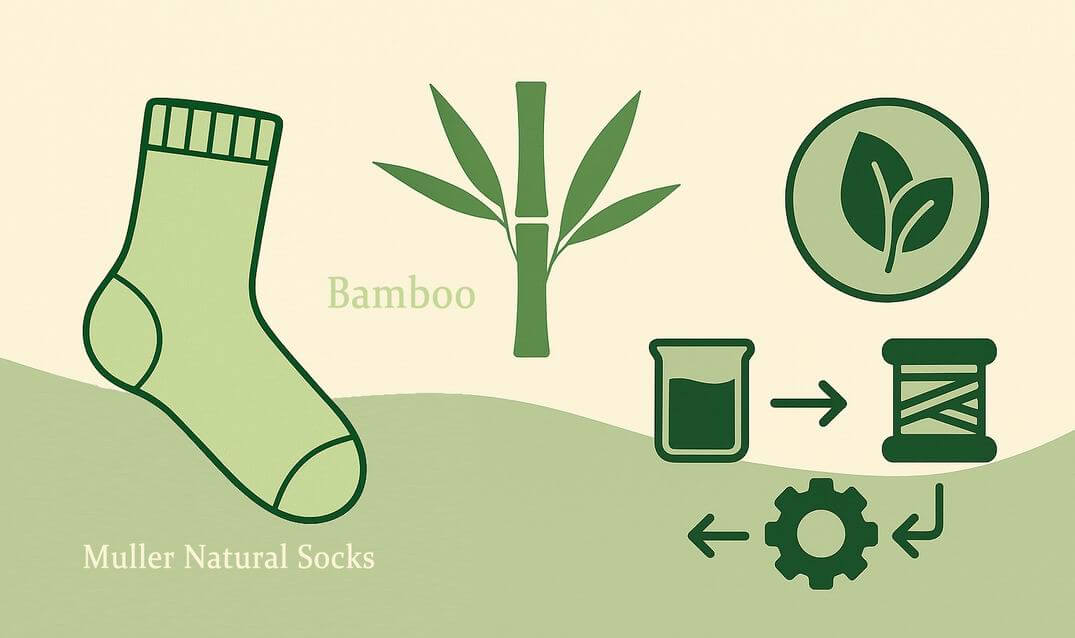
The production of bamboo fibre yarn typically involves three main stages: pulping, fibre formation, and spinning.
— Pulping: Mature Moso bamboo is harvested, chipped and processed to remove lignin and impurities, creating high-purity bamboo pulp. The quality of this pulp determines the yarn’s consistency and strength.
— Fibre formation: The pulp is dissolved into a viscous solution and extruded through fine spinnerets into a coagulation bath, forming solid fibres that are then washed, dried and cut.
— Spinning: The fibres are carded, drawn and spun into yarn through ring or compact spinning. The chosen spinning method influences the yarn’s strength, smoothness and durability—key qualities for everyday socks.
This carefully controlled process allows bamboo yarn to deliver an excellent balance of softness, strength and moisture management—traits that are hard to achieve with traditional fibres.
4. Raw Material Sources and Global Distribution
The performance of bamboo fibre yarn depends greatly on the species and growing conditions.
Moso bamboo (Phyllostachys pubescens) is the primary industrial species due to its high cellulose content, uniform structure and suitable fibre length.
Most bamboo resources are concentrated in Asia—particularly in China, India, Thailand and Vietnam—with emerging cultivation in Brazil, Colombia and parts of Africa.
In China, provinces such as Fujian, Jiangxi, Hunan, Sichuan, Guizhou and Zhejiang provide ideal climates for bamboo growth. Moso bamboo matures within three to five years and regenerates naturally after harvesting, ensuring a steady, sustainable supply.
5. Types of Bamboo Fibre Used in Socks Yarn
Bamboo fibre yarn is usually produced from bamboo viscose fibre, while bamboo charcoal fibre serves more specialised uses.
— Bamboo viscose fibre is a regenerated cellulose fibre known for its softness, breathability and antibacterial properties. Its mature production process and stable costs make it the dominant material in bamboo yarn manufacturing.
— Bamboo charcoal fibre incorporates ultra-fine bamboo charcoal powder during spinning, improving odour control and moisture regulation. However, its higher cost and firmer texture mean it’s mainly used for sports or outdoor socks.
Bamboo charcoal fibre may help with moisture absorption and odour reduction, but its long-term antibacterial performance depends on fibre treatment and use conditions.
Overall, bamboo viscose fibre remains the core material for bamboo yarns due to its comfort, versatility and reliability.
6. Yarn Specifications and Blending Practices
The count and blending ratio of bamboo yarn determine how it feels and performs.
— Yarn count:
- Lower counts (e.g. 21s) create thicker, stronger yarns suitable for men’s or athletic socks.
- Medium counts (e.g. 32s) offer a balance of softness and breathability—ideal for business or dress socks.
— Blending:
Pure bamboo fibre feels luxuriously soft but lacks some tensile strength and abrasion resistance. To enhance performance, it’s often blended with:
- Nylon – to boost elasticity and durability;
- Cotton – to add texture and reduce cost;
- Spandex (Elastane) – to provide stretch and better fit.
Through thoughtful blending, bamboo yarn achieves the ideal mix of comfort, resilience and functionality required for sustainable sock production.
7. Global Supply Chain and Industrial Leadership
Beyond its natural and technical advantages, bamboo fibre yarn has become the preferred choice for sustainable socks thanks to its well-established international supply chain—largely driven by China.
China leads the world in bamboo fibre and yarn production, supported by an integrated system that covers every stage from raw bamboo harvesting to finished yarn spinning. This structure ensures consistent quality, dependable supply and cost-effective production—key factors for apparel brands and retailers worldwide.
China’s expertise in bamboo fibre technology and large-scale capacity has positioned it as the central hub of the global bamboo yarn industry, making the material readily available and affordable for sustainable textile manufacturing.
Contact Us
Don’t miss out on the opportunity to partner with a trusted bamboo socks manufacturer from China. Let us help you create products that resonate with your customers and elevate your brand.